Sartiz Alam Ayon
Dhaka / ··

Hey 
I’m Sartiz.

I teach Computer Science at BRAC University and research multimodal foundation models for biological reasoning. Previously, I was a Nextern in Grameenphone's AI & I program, where I worked across internal AI systems, enterprise AI initiatives, and organizational AI strategy.

b.sc. cs, brac university
still the same hoodie

02 / the work

Five things. Open one.

Five of us built this for our undergraduate thesis. The problem is easy to say out loud. Protein language models will happily tell you what a protein probably does, but they will not tell you why, and a biologist cannot act on an answer they are not allowed to check.

So we gave the model something to reason from. We took the 250,000 proteins in Prot2Text, clustered them down to 87,384 with MMseqs2 so nothing in the set was a near copy of anything else, then attached an evidence pack to every entry: Pfam domains, DeepLoc localisation, DeepTMHMM topology, SignalP peptides. GPT OSS 20B turned each pack into four short reasoning steps with a confidence score, and a validator quietly binned anything that cited evidence the protein did not actually have.

Training runs twice. First a projector we call MSPP 128 learns to squeeze a frozen ESM 2 into 128 tokens a language model can actually read. Then LLaMA 3.1 8B learns, through QLoRA on two T4 cards, to write the reasoning first and the answer second.

My favourite result is the least glamorous one. Reasoning before answering beat answering alone, 0.777 to 0.821 BERT F1 across sixteen matched variants. And one clear paragraph beat a tidy four step chain, which is not what any of us had bet on.

reasoning traces esm 2 + llama 3.1 qlora 87k proteins
read the thesis · brac university code stays private until the paper lands
01 evidence packuniprot + 4 tools
{{ r.ch }}
{{ e.k }} {{ e.v }}
02 reasoning tracesgpt oss 20b
{{ t.id }} {{ t.label }} {{ t.c }}
mean confidence per trace, across 87k proteins
03 mspp 128esm 2 frozen
fine
k=8
k=32
three views of one sequence, resampled into 128 prefix tokens
04 sixteen variantsbert f1
v1 no reasoning 0.777 v7 0.821
Supervisor
Dr. Farig Yousuf Sadeque
Co-supervisor
Dr. Swakkhar Shatabda
Dataset
87,384 proteins
Where
BRAC University

Pancreatic ductal adenocarcinoma is usually found late and modelled thinly, one modality at a time. HydraNet gives each modality its own head: a 3D-CNN over 32×224×224 tumour slabs, a gated residual network over fifteen genomic principal components plus clinical fields.

Then, instead of concatenating them, the genomic profile queries the image. Scaled dot product attention decides which radiomic features matter given this patient’s molecular context. Three heads come out the other side: survival, necrosis percentage, tumour site, trained together so the auxiliary tasks regularise the hard one.

Twenty six patients. A saliency map for every prediction, because a number without a reason is not usable in a clinic.

3d cnn cross modal attention multi task saliency
sartizalamayon/HydraNet · full write-up
genomeQ
ct volumeK V
clinicalQ
the resulting attention: where the genome told the image to look
Tumour site
83.3% accuracy
Necrosis
7.6% MAE
Survival
66.7% accuracy
Cohort
26 patients

803 engineering students, fourteen universities, 47 questions each. We scored everyone with PHQ 9, drew the line at ten, then deleted the PHQ 9 answers from the training data so the model could not simply read the answer key back to us.

Far fewer students landed on the depressed side, and that kind of imbalance quietly ruins a classifier. The usual fix is to generate the rows you are missing. What nobody agrees on is how to tell whether the rows you generated deserve to be believed, so we wrote a score for it: distribution similarity, correlation preservation, class balance, feature importance, privacy. SMOTE won on evidence rather than habit, at a KS statistic of 0.016 against CTGAN at 0.143.

Then eight classical models and three deep ones. XGBoost came out ahead at 96.25% accuracy. The leaderboard was never the point though. SHAP, LIME and ALE all pointed at the same handful of features, and a year later I went back and found out something about when we had collected the answers.

four generatorsks statistic
{{ g.label }} {{ g.v }}
shorter is closer to the real distribution
eight classicalf1
{{ m.label }} {{ m.v }}
axis starts at 0.70, not zero
Best model
XGBoost · F1 0.9651
Explainability
SHAP · LIME · ALE
Supervisor
Annajiat Alim Rasel

Most clinical RL work hands the agent a reward function someone typed out on a Tuesday. This one learns the reward from expert judgement instead: pairwise trajectory preferences, fitted with a Bradley-Terry model, in a true dynamical environment where actions change the future state.

Then a Lagrangian penalty on top of PPO, so intervention frequency is a constraint rather than an afterthought. The interesting outcome isn’t the return. It’s that the policy refuses to collapse. No 0%. No 100%. It hesitates, which is what a good clinician does.

sartizalamayon/Human-in-the-Loop_RL_for_HCD
in range out of range intervened
Preferences
1,989 pairs
In range (test)
59.7%
Intervention rate
54.2%
Method
Constrained PPO

I led the system architecture. Crop disease detection from photographs, fused with a yield and growth stage model, tuned with Bayesian optimisation, fed by NASA satellite APIs and more than ten thousand processed images.

The part I am still proud of is the last mile. You give it soil type, watering frequency, fertiliser, sunlight hours, temperature and humidity. It gives you back a growth stage, and then it turns that stage into a sentence a farmer can act on this week. A prediction nobody can read is not a decision support system.

sartizalamayon/nsac-model · the served model
what goes insix fields
{{ i.k }} {{ i.v }}
what comes backgrowth stage
{{ s.name }}
and then, in words

Flowering has started. Hold nitrogen back, water every third day, and check the lower leaves for the spotting we flagged in the north corner.

disease passone field
flagged watch clear
NASA Space Apps
1 of 947 finalists
Field
9,900+ teams
Stack
PyTorch · FastAPI

There is also a self supervised chest X ray study (ResNet 18, contrastive pretraining, AUC 0.9591 under low label conditions). Plus some other repositories: built software, course projects and more. Go digging.

03 / the path

2010 to now.
2022
day one
january 2022

Started Computer science at BRAC University.

I had been sitting too close to a screen since I was eleven; this was the first time anyone graded me for it.

2022

IEEE student branch. Most Valuable Volunteer.

Registration desks and late event nights, and the first group of people who cared about the same things I did. Around the same time I started donating blood at Bangladesh Thalassemia Samity Hospital, which I still do.

june to november 2024

First research experience.

Survey answers from 803 students across fourteen Bangladeshi universities based on PHQ-9 levels, trying to understand what causes depression among students.

october 2024

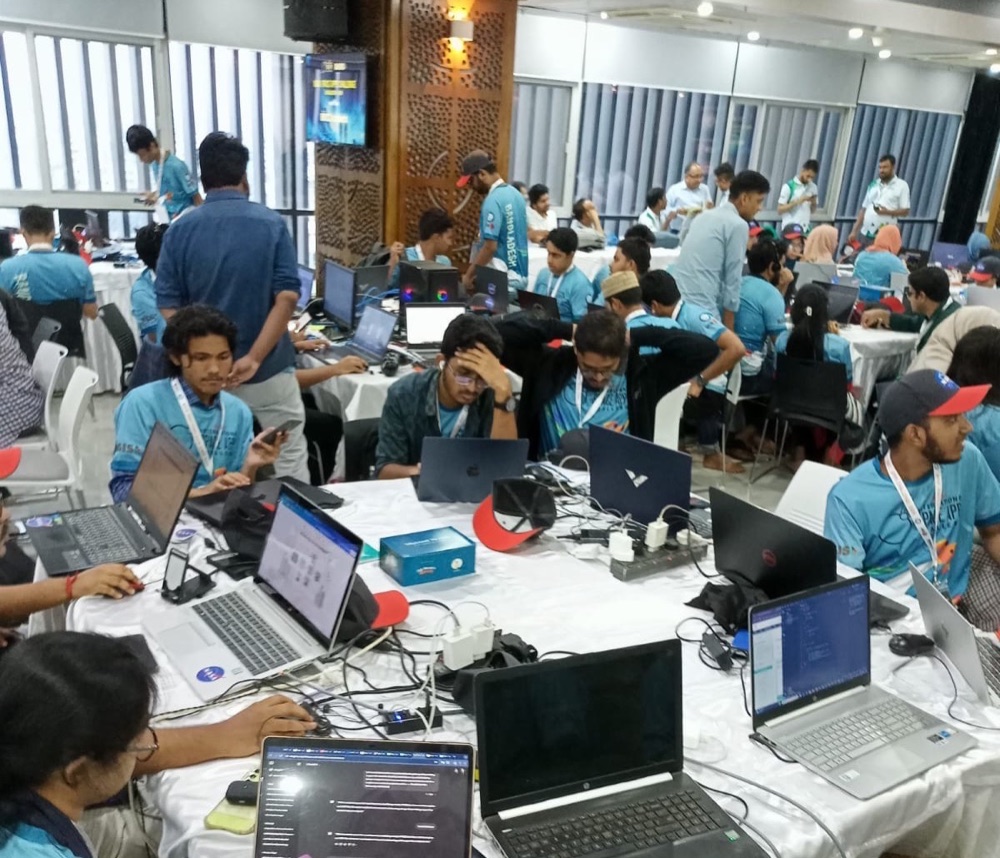
NASA Space Apps Challenge, global nominee.

One of 947 finalists from more than 9,900 teams. I led the architecture.

GLOBAL NOMINEE UNIVERSAL EVENT, USA
NASA Space Apps Challenge 2024
space apps 2024, dhaka
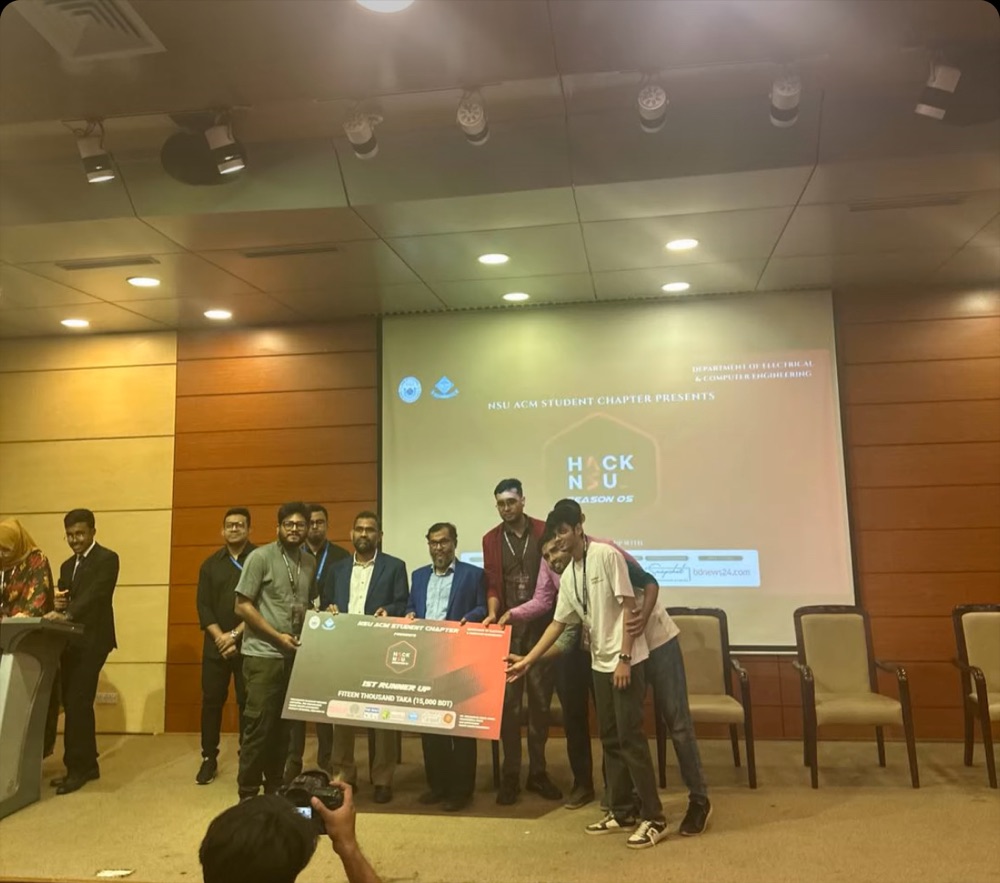
HackNSU Season 5 runner-up
hacknsu season 5, runner-up
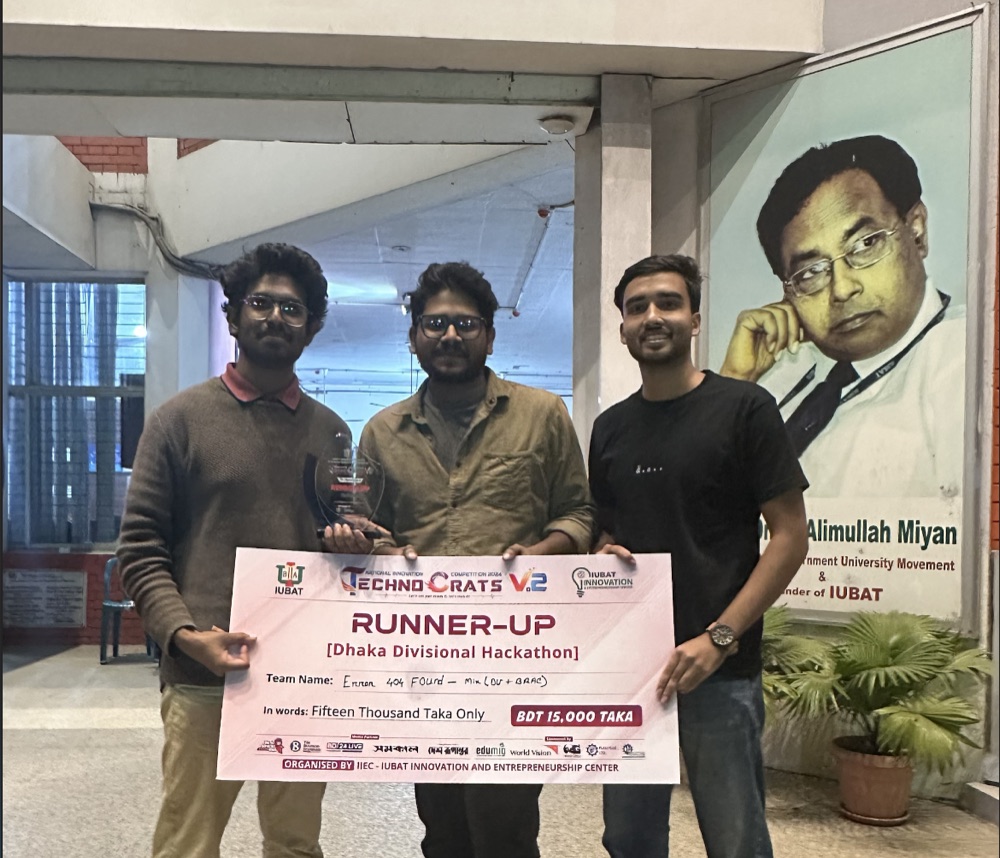
National Innovation Competition runner-up
national innovation, dhaka
january 2025

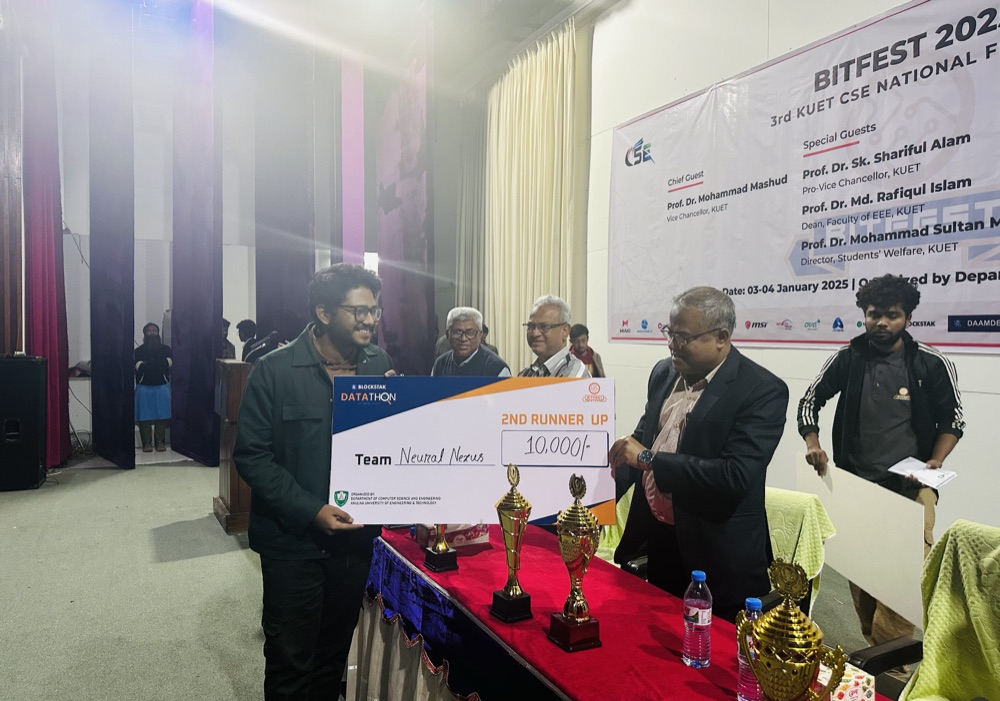
Third in the country at KUET Bitfest.

140+ university teams. Ealier that year, 39th of 150 at the CUET CSE Fest datathon.

Datathon prize at KUET Bitfest 2025
bitfest 2025, kuet
february 2025

Undergradute thesis started.

Protein function, five people.

june 2025 to january 2026 role

Teaching assistant, School of Data and Sciences.

Teaching has changed how I learn. I’ve realised there are depths to concepts I didn’t fully understand until I had to explain them to someone else. I tought and mentored hundreds of Computer Science students each semester across core CS topics. 

february 2026

Graduated. 

Dean’s List twice, Vice-Chancellor’s List twice. Four years that went away so fast, I graduated with the highest distinction.

dean’s list ×2 vice-chancellor’s list ×2 MERIT BASED SCHOLARSHIP
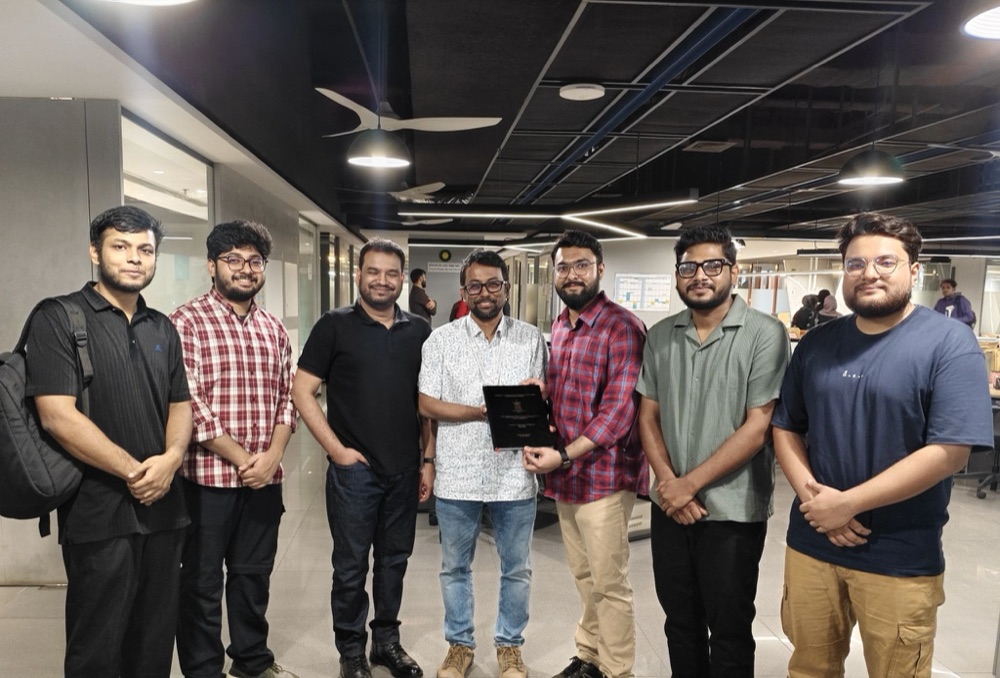
With Dr. Farig Yousuf Sadeque and Dr. Swakkhar Shatabda after the thesis defence
after the defence, with farig sir and swakkhar sir
june to august 2026 role

Grameenphone, AI & I program.

I worked as a Nextern in at CEO's Office under the AI & I program, where my work spanned internal AI systems, enterprise initiatives, and AI strategy. It was my first sustained experience with what happens when AI leaves the notebook and enters a real production environment. Beyond the technical side, I saw how governance, trust, and organisational alignment shape whether AI actually gets adopted. I learned that building the system is only part of the challenge, small yet well designed initiatives can create the momentum needed to drive adoption at scale.

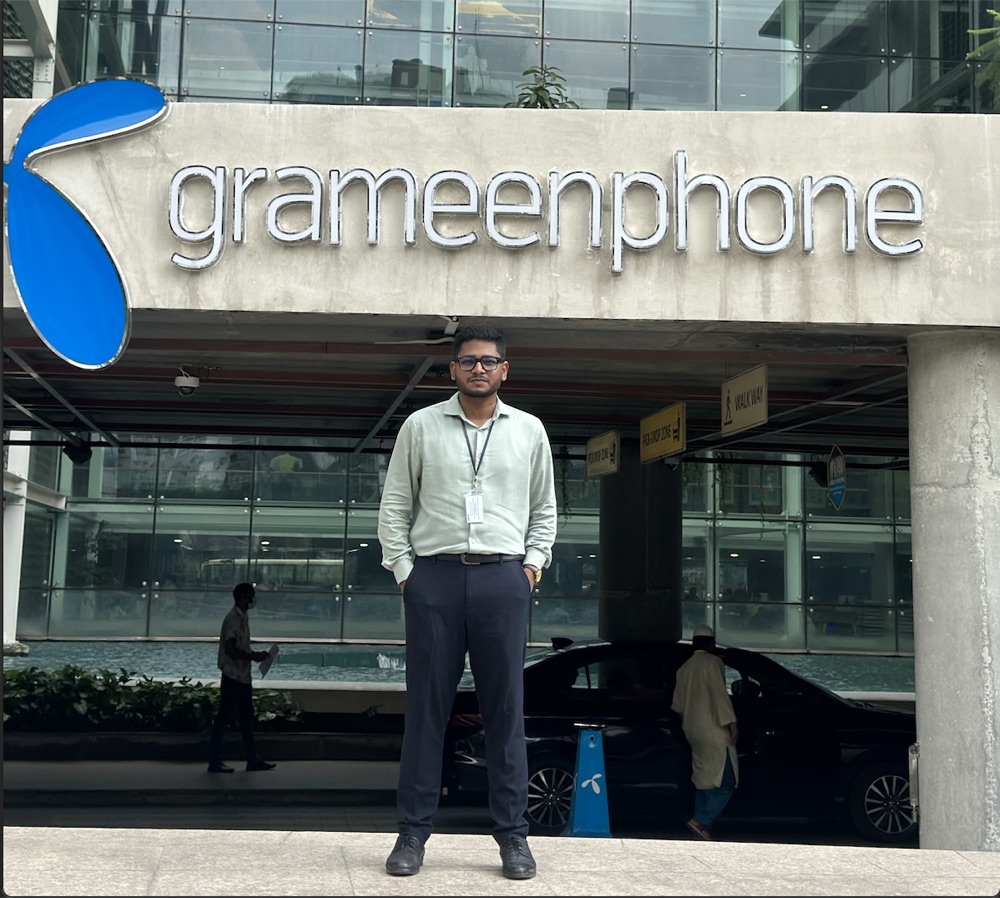
First day at Grameenphone
day one, grameenphone
august 2026 → role

Adjunct lecturer, Department of Computer Science and Engineering.

Teaching undergraduate computer science in the department I graduated from six months earlier. Same building, other side of the desk.

04 / reach me

That’s most of it. The rest is easier over email.

sartiz.a.ayon@gmail.com
GitHub LinkedIn Kaggle Writing